
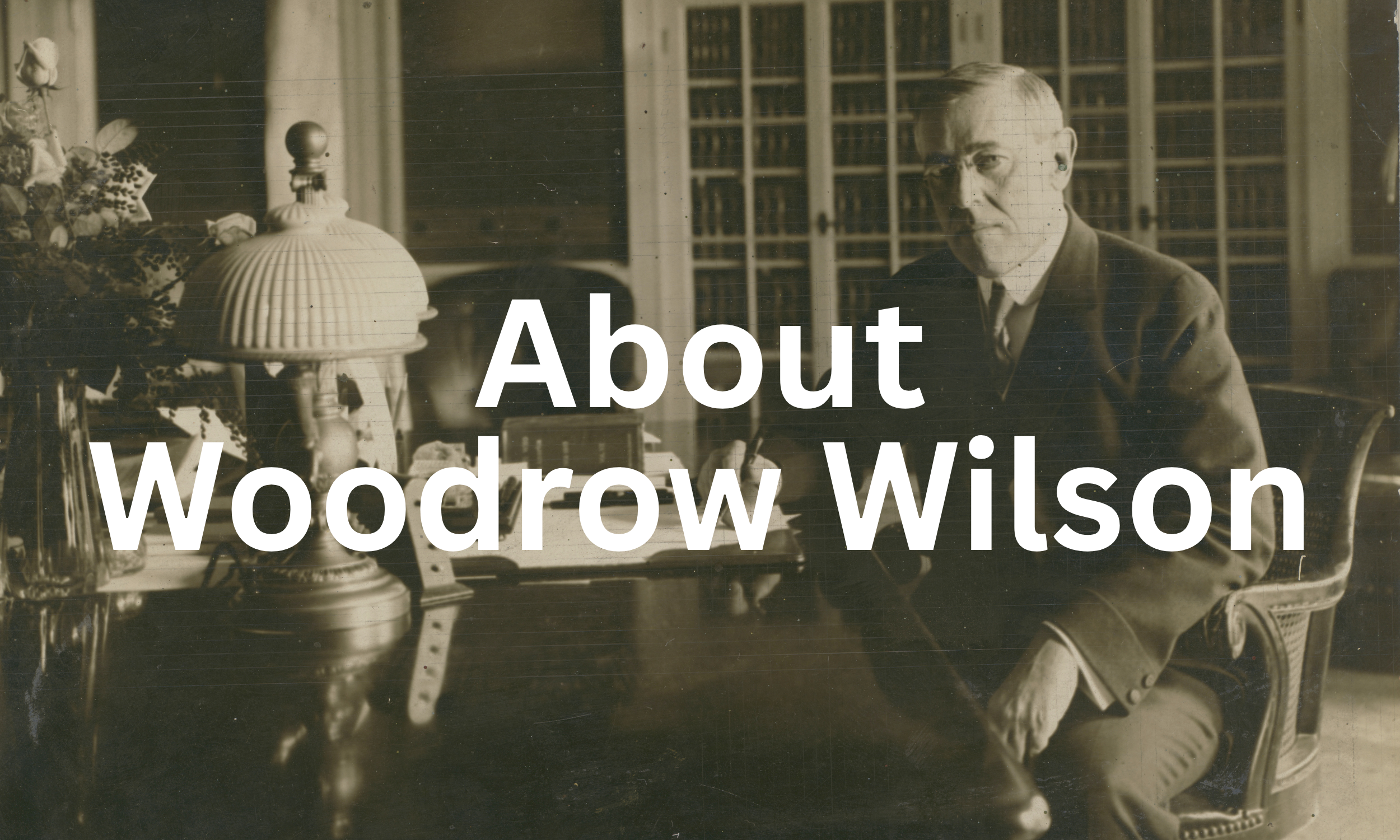

Thomas Woodrow Wilson was born December 28, 1856, in Staunton, Virginia. He was the third child of Reverend Joseph Ruggles Wilson and his wife, Janet “Jessie” Woodrow Wilson. Reverend Wilson was the minister of the Staunton Presbyterian Church and lived in the church’s manse. The home and three leased enslaved people were provided by Staunton Presbyterian Church. Called “Tommy” as a child, the future US president moved with his family to Augusta, Georgia in 1858 when his father was invited to be the minister for the Augusta Presbyterian Church. The Wilsons lived in Georgia during the Civil War and early years of Reconstruction. Wilson saw his father’s church turned into a hospital for wounded soldiers. The Wilsons moved to Columbia, South Carolina when Woodrow was thirteen. Wilson’s childhood in the South affected his later beliefs toward war and race relations.
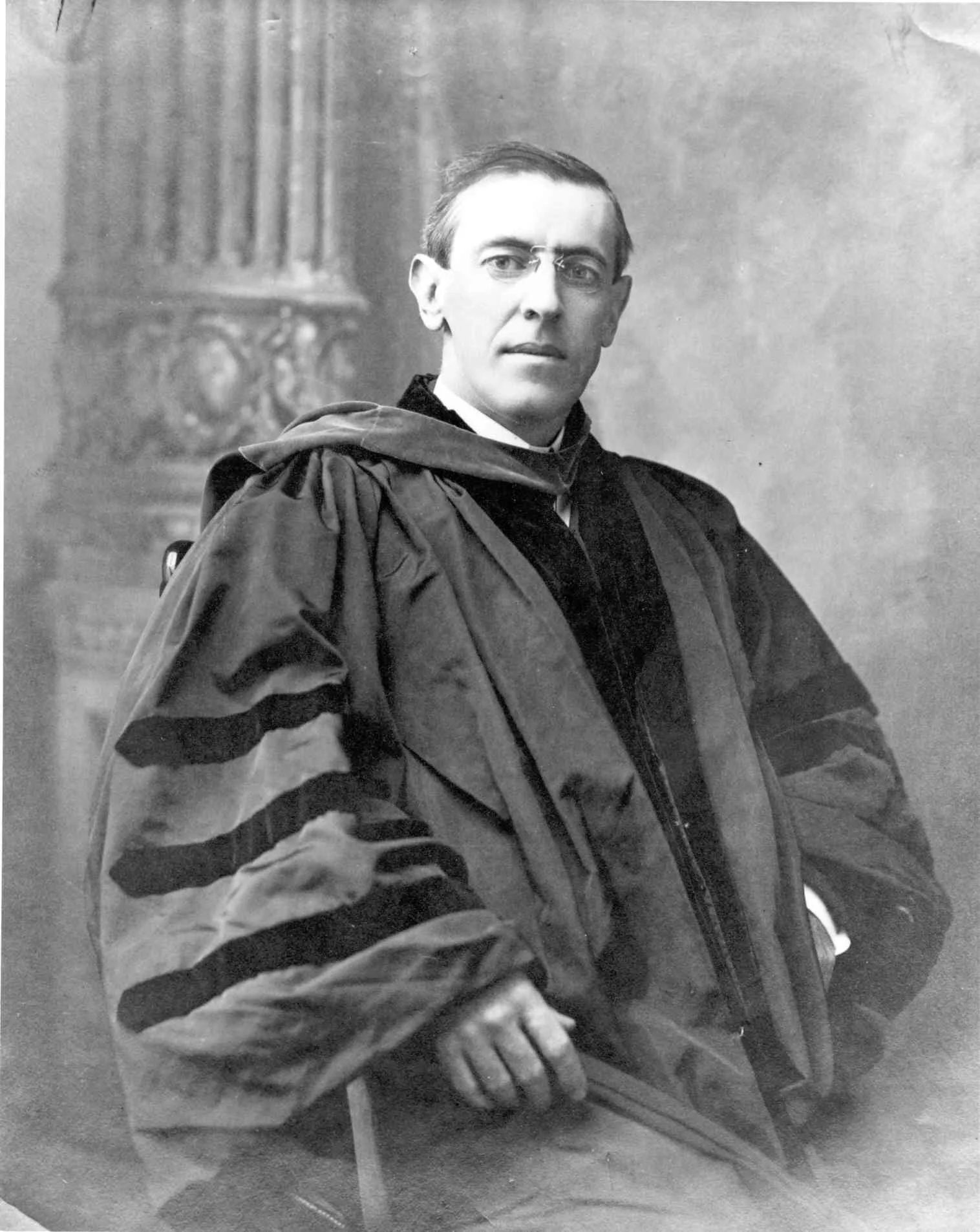
Wilson attended Davidson College for one year before transferring to the College of New Jersey (now Princeton University), where he graduated in 1879. He then attended the University of Virginia School of Law for one year but did not complete his degree. After studying independently, he passed the Georgia bar, only to discover that he had little interest in practicing law.
In 1883, Wilson returned to academia, enrolling at Johns Hopkins University, where he earned a Ph.D. in history and political science in 1886. He remains the only U.S. president to have earned a Ph.D.
In June 1885, Wilson married Ellen Louise Axson, the daughter of a Presbyterian minister. Together they had three daughters: Margaret, Jessie, and Eleanor.
After teaching at Bryn Mawr College and Wesleyan University, Wilson joined the faculty at Princeton University in 1890 as a professor of political science. He quickly became popular with both students and faculty, and in 1902 he was elected president of the university. Wilson remained at Princeton until he was elected Governor of New Jersey in 1910.
Elected President of the United States in November 1912, Wilson was inaugurated in March 1913. During his first term in office, he oversaw a number of significant social and economic reforms, including the creation of the Federal Reserve Act of 1913, the Keating-Owen Child Labor Act of 1916, and laws that strengthened labor protections for working Americans.
At the same time, Wilson's administration significantly expanded racial segregation within the federal government. African American employees were forced to work in separate spaces and use separate facilities from their white colleagues, reversing decades of integration in many federal offices.
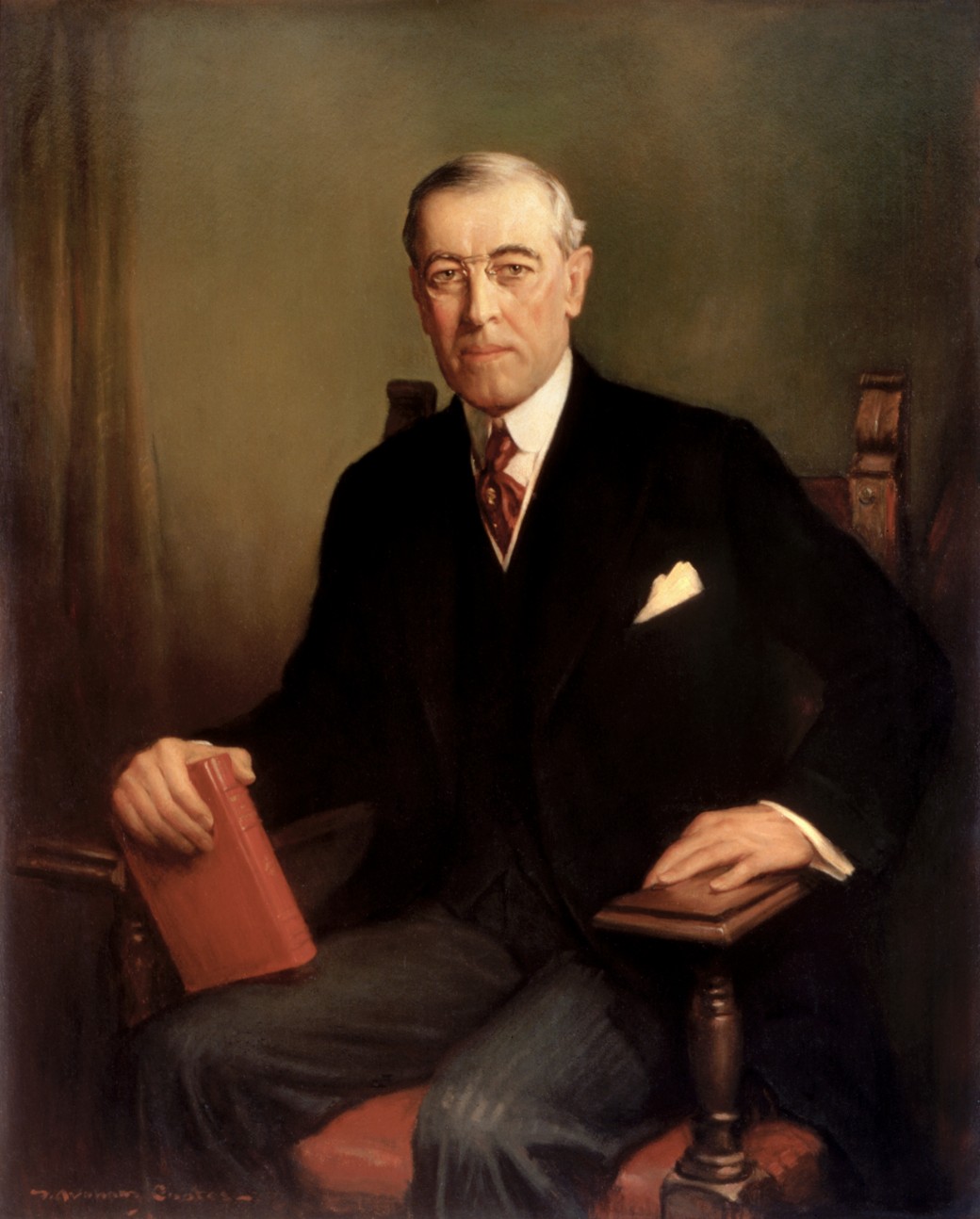
After his wife, Ellen, died of Bright's disease in July 1914, Wilson entered a period of deep grief. The following March, he was introduced to Edith Bolling Galt, and the two were married in a small ceremony at her home in December 1915.
In 1916, Wilson was elected to a second term in office. His efforts to keep the United States neutral in the war in Europe (now known as World War I) were a central theme of his campaign. By April 1917, however, the United States had declared war on Germany.
Wilson is often remembered for his leadership during World War I and his efforts to establish the League of Nations. In January 1918, he proposed his "Fourteen Points" as a framework for future peace. At the Paris Peace Conference following Germany’s request for an armistice, Wilson advocated for those principles during negotiations with the Allied leaders. Although the Treaty of Versailles incorporated many of his ideas, the United States Senate refused to ratify the treaty or approve American membership in the League of Nations.
While touring the country in 1919 to build public support for the League, Wilson became exhausted and suffered a debilitating stroke from which he never fully recovered. In the months that followed, Edith Wilson and the president's physician, Dr. Cary Grayson, carefully controlled access to him and limited public knowledge of the severity of his condition, leading historians to continue debating the extent of Edith Wilson's role during the remainder of his presidency.
During both of his presidential campaigns, Woodrow Wilson maintained that women's suffrage was a matter for individual states rather than the federal government or a constitutional amendment. As a result, many suffragists viewed him as an obstacle to the proposed Susan B. Anthony Amendment, and members of the National Woman's Party picketed outside the White House for more than two years.
When the United States entered World War I, women assumed many roles that had traditionally been held by men, including work in factories and on farms. Combined with years of advocacy by suffrage organizations, these contributions helped change Wilson's position. In a 1918 address to Congress, he publicly endorsed women's suffrage for the first time during his presidency, asking:
"We have made partners of the women in this war… Shall we admit them only to a partnership of suffering and sacrifice and toil and not to a partnership of privilege and right?"
After leaving office in 1921, Wilson and his wife, Edith, moved to a home in northwest Washington, D.C. He died there on February 3, 1924, at the age of 67 and was laid to rest in Washington National Cathedral. Following his death, Edith helped establish the Woodrow Wilson Birthplace Foundation, now known as the Woodrow Wilson Presidential Library & Museum.

