
The Fourteen Points: Woodrow Wilson's Blueprint for Peace
/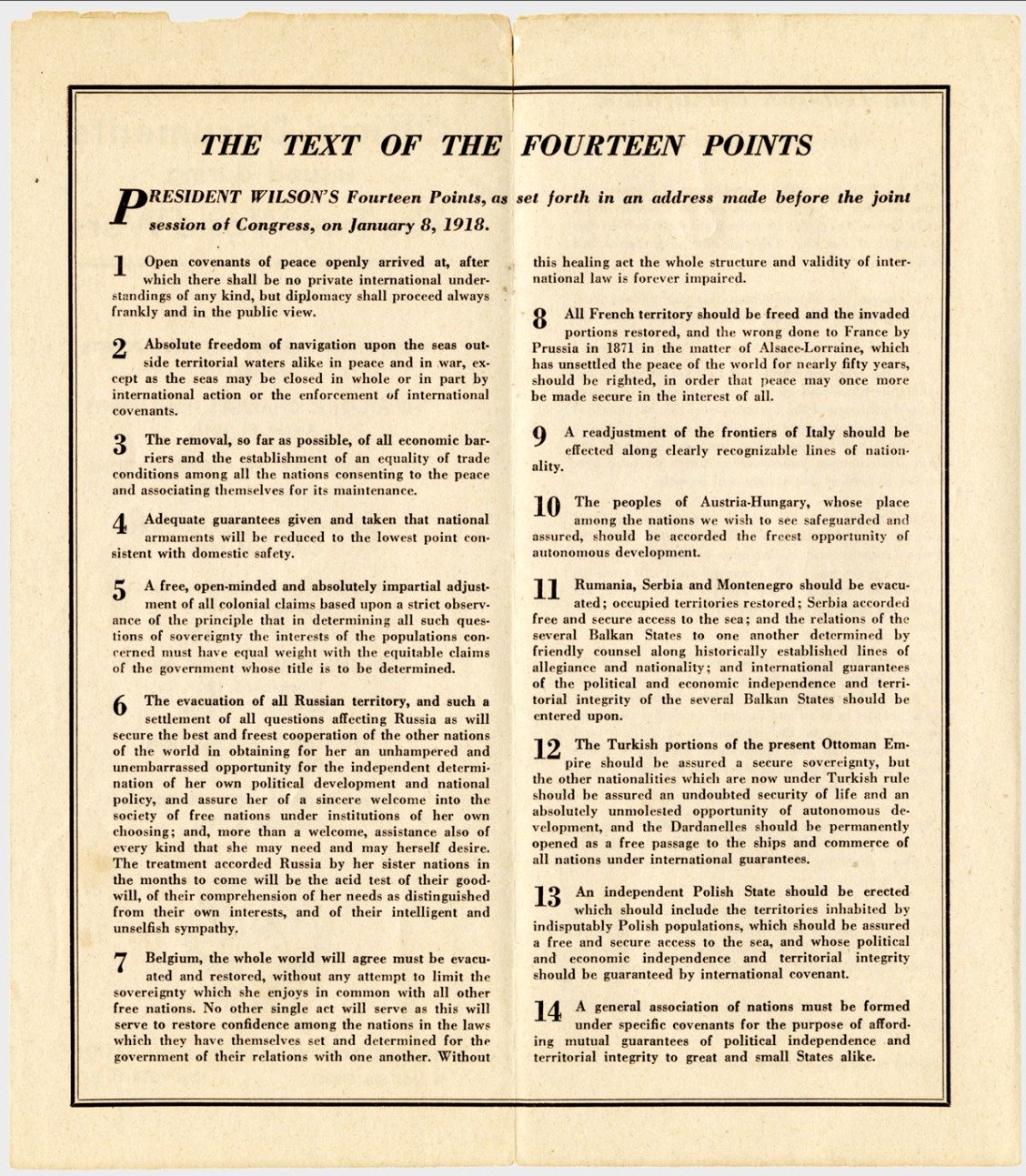
On January 8, 1918, President Woodrow Wilson addressed Congress to outline the USA’s goals for World War I. America did not want colonies or reparations, instead it demanded “the world be made fit and safe to live in; and particularly that it be made safe for every peace-loving nation.” Wilson sought a peace which would prevent future conflicts. His speech, known as the Fourteen Points, would reshape international relations and lay the groundwork for modern diplomacy.
From War to Peace
Nearly a year after asking Congress to enter the war to "make the world safe for democracy," Wilson presented his plan for a just and lasting peace. The Fourteen Points addressed immediate territorial disputes while proposing fundamental changes to how nations interacted with one another.
Key Principles
Wilson's plan included several groundbreaking concepts:
Transparency and Trade:
Open diplomacy with no secret treaties
Freedom of the seas
Removal of economic barriers and equal trade conditions
Reduction of armaments
Self-Determination: Wilson championed the right of people to choose their own governments, particularly for those living under the collapsed empires of Europe. The plan called for the restoration of Belgium, the return of Alsace-Lorraine to France, the creation of an independent Poland, and autonomy for peoples of Austria-Hungary and the Ottoman Empire.
The League of Nations: Point 14 proposed "a general association of nations" to guarantee political independence and territorial integrity for all countries. This became the League of Nations, Wilson's most cherished, and controversial, proposal.
The Paris Peace Conference
When Wilson traveled to Paris in December 1918, he faced harsh realities. Allied leaders had different priorities: France wanted to prevent Germany from ever being a threat again, Britain sought to preserve its empire, and Japan demanded territorial gains in Asia. Wilson compromised on many points to secure the League of Nations in the Treaty of Versailles.
Defeat at Home
After months of negotiations in Europe, Wilson returned to face another obstacle; the U.S. Senate. Senator Henry Cabot Lodge led opposition to the League, arguing it would entangle America in European affairs. Unwilling to compromise with his opponents in the Senate, Wilson embarked on a nationwide speaking tour to rally public support, but suffered a debilitating stroke in October 1919. Without his leadership, the Senate rejected the Treaty of Versailles in March 1920, and the United States never joined the League.
A Lasting Legacy
Despite this defeat, Wilson's vision endured. The League of Nations operated throughout the 1920s and 1930s, and when it ultimately failed to prevent World War II, world leaders revisited Wilson's principles. The United Nations, founded in 1945 with the United States as a charter member, was built directly on the Fourteen Points' foundation.
Wilson's promotion of self-determination resonated far beyond Europe. Many independence movements across Asia, Africa, and the Middle East used his words in their struggles throughout the 20th century.
Why It Still Matters
More than a century later, the Fourteen Points remain relevant. The principles of open diplomacy, collective security, and international cooperation continue to guide organizations like the UN and NATO. Wilson's vision was imperfect; self-determination was applied selectively and harsh treaty terms contributed to future conflicts. However, his belief that nations could work together to prevent war remains one of the most important ideas in modern international relations.
Visit the Woodrow Wilson Presidential Library and Museum to explore President Wilson's legacy and the transformative era that shaped modern America.

Sources
Wilson, Woodrow. "President Woodrow Wilson's Fourteen Points." Address to Congress, January 8, 1918. Avalon Project, Yale Law School. https://avalon.law.yale.edu/20th_century/wilson14.asp
Wilson, Woodrow. "Address to Congress Requesting a Declaration of War Against Germany." April 2, 1917. National Archives. https://www.archives.gov/milestone-documents/president-woodrow-wilsons-declaration-of-war-message
"President Woodrow Wilson's 14 Points (1918)." National Archives. https://www.archives.gov/milestone-documents/president-woodrow-wilsons-14-points
Manela, Erez. The Wilsonian Moment: Self-Determination and the International Origins of Anticolonial Nationalism. Oxford University Press, 2007.
Knock, Thomas J. To End All Wars: Woodrow Wilson and the Quest for a New World Order. Princeton University Press, 1992.
MacMillan, Margaret. Paris 1919: Six Months That Changed the World. Random House, 2001.
Cooper, John Milton. Woodrow Wilson: A Biography. Knopf, 2009, pp. 530-565.
"History of the United Nations." United Nations. https://www.un.org/en/about-us/history-of-the-un
Manela, Erez. The Wilsonian Moment, pp. 3-22.
Kennedy, David M. "Woodrow Wilson's Fourteen Points." The American Prospect, January 8, 2018.https://prospect.org/power/woodrow-wilson-s-fourteen-points/

